2015年04月28日
万达帝国王健林:游刃于商业与权贵之间
傅才德
香港——他在全世界控制着成千上万的银幕,服务的电影观众比其他任何一家院线都多。他在四个大洲向房地产项目投入巨额资金。他正在修建的摩天大楼将会重绘伦敦和芝加哥的天际线。他也在计划收购一家好莱坞的电影制片厂。
在中国,身家过10亿美元的富豪多达430人,比美国以外的其他任何国家都多。但是王健林与众不同,原因不仅在于他是亚洲最富有的人,他的财富据估算超过350亿美元。
随着他的房地产和娱乐帝国向海外延伸,现年60岁的王健林凭借他在全球许多产业和社区的影响力,也成了中国私营部门并不多见的一位有能力在海外推进官方利益的大亨。
总理曾向他发函致谢,好莱坞最大的明星会听他的召唤,来到中国。今年3月,在一场吸引外国投资者的活动上,他是十几位与奥巴马总统晤面的商人中的一个。
父亲是毛泽东麾下参加共产主义革命的马前卒,儿子却一跃成为全球的顶级精英,这是中国向资本主义转型的过程中一个极为典型的故事。这场转变向 有才能或者有关系的人提供了极大机遇,而王健林可以说是既有才能,又有关系。不过,他的故事也是独一无二的:在一个所有土地都归政府所有的国家里,他建起 了全世界最有价值的房地产资产组合之一。
关于他的成就,《纽约时报》开展了长达一年的调查。调查揭示了在中国经济的顶峰,商业和权力鲜为人知地交汇在一起。在那里,共产党领导人的一时兴起,就能左右市场竞争的格局。
在过去超过30年的时间里,企业家推动了中国飞速的经济增长。然而在中国,即使是最成功的商人,也仍然需要与党达成某种合作——仅仅在一代人以前,党还在掌控着一个社会主义的计划经济社会。
王健林表示,他之所以能发迹,是因为向雄心勃勃的党内官员提供了他们想要的东西:作为样板工程的房地产开发项目。这些项目既能推动经济发展,又能推动官员的事业。他说,作为回报,官员则愿意以优惠价格把关键地块的开发权卖给王健林,远低于竞争对手需要支付的价钱。
他的企业集团万达,在中国最为著名的项目是标志性的万达广场。这些宏大的购物广场项目里,有影院、写字楼、宾馆和公寓。自从2002年在东北 城市长春兴建第一座万达广场以来,他已经在中国另外70座城市修建了超过100座。这些项目产生的收益如今为他向海外扩张的雄心提供了资金支持。
然而王健林与政府的关系当中,有一个方面他从未在采访中提及,在中国国内和国外对他成功故事的叙述中,这方面也从没有得到报道:中国最有权势的一些政治人物的亲属,以及他们的商业伙伴,在万达集团持有相当部分的股份。
通过仔细查阅公司向政府机关提交的文件,时报发现在2007年至2011年之间,有过数宗这样的投资。那时万达还未上市,极少向外界出售股份。
早期获得机会买到该公司股份的人当中,有一位是齐桥桥。她是一位活跃的投资者,也是中国现任国家主席习近平的姐姐。(2013年10月,她已经将持有的万达股份出售或转让给了一位长期的商业伙伴。)
通过查阅文件记录,采访家庭成员和商业伙伴,时报得知其他的早期投资者包括前总理温家宝女儿的一个商业伙伴,以及时任政治局委员贾庆林和王兆国的亲属。
去年12月,当王健林名下负责房地产业务的大连万达商业地产股份有限公司在香港首次公开发行时,他们在该地产公司的股份总价值11亿美元。而 在王健林负责电影业务的子公司今年1月单独上市时,他们在该电影院线所持股份价值1720万美元。目前,他们在两家公司持有的股份总价值逾15亿美元。
没有迹象表明,在亲属及生意伙伴拥有万达股份的相关政界人物中,有任何人代表该公司干预了与政府进行的任何交易。也没有证据表明,前述政界人 物中有任何人自身从这些投资者的巨额利润中获利。这些投资者以及政府官员或是没有回应书面提出的采访问题,或是无法联系到本人进行置评。
王健林拒绝了采访请求,也未回复提交给万达及代表万达的公关公司的书面问题。但在公开发言中,他经常用同一句话来描述自己是如何处理与当局的关系的:"亲近政府、远离政治。"
"实际上,就说中国经济是政府主导型经济,而且房地产又是一个审批型为主的行业,"王健林今年2月接受官方电视台的采访时说。"所以你要说这个行业我不理政府,完全做不到,我觉得完全就是一种虚话和假话。……但是同时,比方说,[我们]不行贿。"
商海弄潮 一帆风顺
2012年9月,一位不同寻常的演讲者让哈佛大学(Harvard)肯尼迪政府学院(John F. Kennedy School of Government)的学生着了迷。他个头不高,言辞直率,两眼间距不大,发际线呈明显的V字型。
"在中国尤其是民营企业能成功做大太不容易了,"他通过翻译说,"比美国企业家要艰辛好多倍。"
如果教职人员这么说,就算不上什么不同凡响的洞见。但那天下午的演讲人是王健林,而且尽管存在他所说的困难,他依然在连战连捷。
在发表演讲的几个月前,王健林收购了美国第二大连锁院线AMC娱乐控股(AMC Entertainment Holdings)。到当年年底,他在中国境内的帝国就包括了66座万达广场、38家五星级酒店、980块银幕和57家百货商场,更别说还有63家卡拉 OK店。在接下来的一年时间里,他在海边城市青岛开工建设了一座投资80亿美元的影视制作和主题产业园,莱昂纳多·迪卡普里奥(Leonardo DiCaprio)、妮可·基德曼(Nicole Kidman)、约翰·特拉沃塔(John Travolta)等明星纷纷飞去庆祝。
伴随着成功而来的,是超级富豪标志性的一掷千金。王健林出资2820万美元拍得一幅毕加索(Picasso)的画作。他妻子结交的是摩纳哥的阿尔伯特亲王(Prince Albert)。他儿子雇了韩国的一个顶级流行音乐组合在自己的27岁生日聚会上表演。
不满于仅仅拥有一艘游艇的王健林,收购了一家英国公司。在詹姆斯·邦德(James Bond)系列电影中出现的豪华游艇就是由该公司建造的。今年1月,王健林的公司宣布将购买西班牙某足球俱乐部的部分股份。
"他有一股超人的力量,"与王健林认识超过三年的梦工厂动画电影公司(DreamWorks Animation)首席执行官杰弗里·卡岑伯格(Jeffrey Katzenberg)说。"他的个性非常非常强,对自己在做的事情极度自信。"
王健林的父亲是一名老战士,参加过共产党具有传奇色彩的长征。共产党上世纪30年代那次穿越中国的跋涉充满艰辛,途中伤亡惨重,磨练了一代革 命者。在五兄弟中排行老大的王健林自己,则在十几岁时便效仿父亲参了军。2013年亮相官方电视台时,王健林回忆说,在毛泽东那场狂热的文化大革命期间, 他曾在训练时在及膝深的雪地里走了2000多华里。
"很多人都是,都坚持不下来,"王健林说。但他坚持了下来。后来,在接下来的16年时间里,他在军队里层层晋升。同事称,这一经历让他形成了自己的管理风格。比如,前员工称,在他手下,就连级别最高的万达高管也被要求上下班打卡,迟到是不能容忍的。
退役后,王健林在东北的港口城市大连找到了一份政府工作。当1988年被调到一个日渐衰败的国有住宅楼开发公司时,他的机会来了。在一名老战友的帮助下,他得到了一笔贷款,并让公司扭亏为盈。
1992年,公司重组,成为中国首批股份制公司之一。在接下来的10年,王健林领导该公司实现私有化,并成为其大股东。
那个时期的大部分阶段,大连的市长一直是薄熙来。后来,父亲是党内一名颇具影响的元老的薄熙来升任政治局委员,并在2012年因为一场令人震惊的腐败和谋杀丑闻而下台。
在薄熙来任内,王健林为大连做出了巨大贡献。他买下了该市的足球队,并帮助该队成了全国冠军。王健林还捐出巨资修建学校。
自薄熙来下台后,王健林一直试图撇开与他的关系。前不久接受采访时,王健林称,因为拒绝行贿,且又和薄熙来关系不好,他在那些年里处境艰难。他说,这限制了他拿地,因为薄熙来领导的政府不卖给他。
"我们还是赚到钱了,但那段时间不好过,"王健林对《彭博市场》(Bloomberg Markets) 杂志表示。
在中国,所有土地的正式所有权都归国家;因此,想在土地上兴建设施的人必须得到国家的同意。多年来,地方政府一直依靠出售长期的土地开发权,为自己的运作提供资金。但谁以什么价位拿到哪些地块,既是经济决策,也是政治决策。
王健林表示,他的公司总是能为有万达的项目的城市带去利益,以至于地方政府现在争相与其建立业务关系,而他要拒绝超过三分之二的提议。
"我们就占据了主动,就具有议价权,"他对哈佛大学的学生说。他接着表示,那就意味着他获得土地的成本,比竞争对手至少便宜一半。
大连万达的招股说明书显示,在中国的房价不断创下新高的同时,该公司购买土地的价格在2011年到2014年期间却下降了逾40%。
中国商业地产联盟副会长王永平说,地方官员都迫切希望与万达合作,一是因为万达的项目为他们带来的税收,另一个原因是万达有雷厉风行的美誉 。能够在18个月内建成一座万达广场,这被称之为"万达速度"。
"中国政府喜欢出政绩,"王永平说。"18个月可能决定他是不是能当区长或省委书记。"
不过,有些掌权者支持王健林却另有原因。
书面记录中的通向权贵之路
2007年7月时,王健林手中还只有几座建成的万达广场。他的资产尚未达到10亿美元,在中国之外几乎没人听说过他或他的公司。在追踪中国富豪净值的胡润百富榜(Hurun Rich List)上,王健林排名第148位。
然而,公司记录显示,那个月末,在北京新成立的一家公司——铭豪控股——获得了王健林名下的旗舰公司万达集团的2.5%的股份,成为最大的外部股东。当时除了铭豪控股之外,万达集团只有一家外部股东,那是王健林的友人在大连经营的一家房地产公司。
这些记录显示,接着,两个月之后,另一家在北京新成立的公司——五谷丰投资咨询公司——获得了大连合兴投资有限公司1.53%的股份,成为万达的第五个股东。王健林是通过持有大连合兴投资的股份来持有他在万达集团的股份的。
这些文件没有显示为何这两家北京的公司会被邀请成为王健林生意的早期投资者。但这两家公司的记录指向了当时中共中央政治局的两名成员的亲属。 这两名政治局委员是多年担任北京市委书记、在中共领导层中排名第四的贾庆林,以及曾经带头支持一项保护私有财产的标志性法律的全国人大高级官员王兆国。
这些记录显示,王兆国的儿子王新宇是第一家公司的控股股东,该公司后来把万达股权转让给了一个名叫杨欣的年轻女子。据王兆国的堂兄弟王兆安说,杨女士是王兆国的外甥女。王兆安在这个家族的河北老家担任村党委书记 。
记录中显示,第二家公司的所有者名叫潘永斌,63岁,他的公司地址、员工和电话号码与贾庆林的女婿李伯潭在北京经营的一家投资公司相同。潘永斌还是李伯潭拥有的多家公司的董事,包括其名下的主要的投资公司。
随着万达在此后几年的繁荣发展,这些早期投资的价值飙升。
根据万达提交给政府的文件,王兆国之子控制的公司用不到50万美元购买了万达的股份, 不过该公司自己的记录中没有显示这笔交易。这些文件中关于第二家公司的信息更加全面,显示那家公司为万达的股权支付了约20万美元。这两笔股权目前的价值 已分别超过6.4亿美元和2.5亿美元。
这两名政治局委员都没有权力直接为万达购买的土地设定价格,也无权直接批准向万达出售土地使用权的交易。但两人所管辖的中共机构帮助王健林获得了极大的社会认知度。
2008年3月,王健林成了中国人民政治协商会议的三位大陆亿万富豪委员之一,这个国家级的议政机构由贾庆林领导,其成员均是中共领导层眼中 有影响力的人物。一名加入了类似机构的中国商人说,有了这一头衔,相当于得到了中共高层领导人的认可 。为了保护自己的地位,这名商人要求不具名。
2007年6月,王健林还被一个中共管控的行业协会评为杰出企业家,此后四年,他又四次获得由王兆国领导或与他有关的组织所颁发的奖项。
这类荣誉向地方官员和潜在的商业伙伴传递的信息是,荣誉的获得者有很深的背景。"至少在中国境内,人们会更愿意和你做生意,而且冒犯你的可能 性也大大降低," 加州大学圣迭戈分校(University of California, San Diego)的学者史宗瀚(Victor Shih)说。
在2008年末全球金融危机爆发之后,中国的房地产市场急转直下。在2008年一年里,上海的房地产类股票暴跌了65%。
不过,万达集团在这一年的表现令人印象深刻,七座新的万达广场破土动工——创下了有史以来的最高记录——使王健林在胡润百富榜上升至第20位,其财富据估算为23亿美元。
接下来的一年,万达再次向外部股东派发股份, 私下出售了公司8.5%的股权。
万达的八名新投资者中包括一家北京公司,该公司由习近平的姐姐齐桥桥以及她的丈夫邓家贵通过一个控股公司网络所持有。
齐桥桥和习近平都是 "太子党",即一个由中共高级领导人的后代组成的权贵团体的成员。他们已故的父亲习仲勋是毛泽东的战友,曾任副总理,后来成为了中国经济改革的先锋人物。
齐桥桥曾在政府和军队担任过多个职位,此后才成为一名商人。在那段时期,她的弟弟习近平正努力在地方政府中向上攀升。
目前尚不知道齐桥桥和丈夫为何会得到投资万达的机会。2009年时,她已经是一名财力雄厚的投资者,在全国各地都有商业往来。与此同时,她的弟弟则已经成为中国国家副主席,并被外界一致认为将成为中共的下一任领导人。
齐桥桥和邓家贵没有答复时报的置评请求。但记录显示,夫妻二人在2012年开始,退出数以亿计美元的投资,当时习近平开始高调打击官员腐败。抛售行动背后的动机目前还不清楚,但当她弟弟的活动把矛头对准了成千上万的官员时,抛售动作降低了他在政治上受到冲击的可能性。
夫妻二人在出售资产时,许多买家和他们之间都没有明确的联系。
但是二人在万达持有的股份2013年10月8日转让给了一个长期商业伙伴,当时他们股份的估值达2.4亿美元,2009年二人买入时的价格是2860万美元。记录没有显示该名商业伙伴买入的价格,但此人曾与齐桥桥和邓家贵在不同的企业岗位上合作超过10年。
万达的另一个新股东,是由清华控股部分持有并管理的一家投资基金。清华控股是北京名校清华大学的投资机构,当时它的主要负责人是胡海峰,时任国家主席胡锦涛之子。没有迹象显示胡海峰曾得益于万达的股份,也没有迹象表明他本人持有任何万达股份。
一些人获得了早期投资万达的机会,但他们的身份很难确定。其中之一是金怡,她在2009年获得了现在价值约2.5亿美元的股份。但她身份证上的地址并不完整,而且在该社区官方的居民记录中,也并没有她的名字。
然而,公司记录显示,金怡是温如春的商业伙伴。温如春别名常丽丽(Lily Chang),是2003年到2013年在任的前总理温家宝的女儿。在北京一家房地产公司的三名合伙人当中,金怡和常丽丽均名列其中。
推动中国文化
去年在瑞士达沃斯,这个聚集了富人和有权势者的年度盛会上,王健林在小组讨论中坐在高盛(Goldman Sachs)首席执行官劳尔德·贝兰克梵(Lloyd Blankfein)和英国副首相尼克·克莱格(Nick Clegg)之间,几乎没有发言。但是,当一个发言者表示,中国关注于领土争端,削弱了在亚洲的影响力时,这位亿万富翁发怒了。
"今天本来是一个经济论坛,不应该涉及政治,"王健林厉声说,"你公开地挤兑中国,我觉得起码不太礼貌。"
随着王健林的财富日益增多,以及其投资在海外延伸,他已经开始直白地倡导中国的利益。在采访和演讲中,他倾向于把自己描绘成中国大企业中务实的代表人物,向担心中国崛起的外国听众传递充满机会的讯息,试图让他们感到安心。
"从党的角度来看,王健林是个完美的工具,"哈佛大学教授约瑟夫·奈(Joseph Nye)说。奈曾提出了"软实力"这个说法,在王健林发言斥责的那场小组讨论中,奈也出席了。
王健林之所以是一个有效的工具,部分原因在于他已经不再单纯是一个房地产开发商了。随着最近几年北京试图让中国房地产市场降温,他开展多元化 举措,向国外转移投资,并进入了文化娱乐行业;比如他的院线在2012年购买了AMC公司位于美国的4000多块银幕之后,成为了全球最大的连锁影城。
万达采取这种战略之时,恰逢中国领导层努力在国内和国外拓展中国文化的影响力。中国的年轻一代越来越多地转向了西方的音乐、电视和电影。
中共中央委员会在2011年10月发表的一份决定中提到,"增强国家文化软实力、中华文化国际影响力"的要求"更加紧迫"。
"这个纲领性文件之后",万达"就大力发展文化产业",北京的清华-卡内基全球政策中心学者张丽华表示。
一些与中共高层领导人有联系的投资者,得以在早期参与万达的行动。记录显示,2010年12月,贾庆林女婿的投资公司收购了万达旗下连锁影城价值900万美元的股份,截至周一,这些股份已经升值到1.31亿美元。
记录显示,同月还有另一笔早期投资,投资方是私募股权公司新天域资本(New Horizon)管理的一家投资基金。新天域是温家宝的儿子温云松(Winston Wen)联合创办的。这些股权目前价值为5.26亿美元。
中央委员会的决定催生的新政策,令万达这样的房地产企业受益。
比如,地方政府被告知,要把土地使用权优先出让给一些开展中华文化促进项目的企业,国有银行被告知,要提供贷款推动国内外的文化事业。中国进出口银行则同意为万达的海外投资项目提供融资,支持其收购AMC。
除了投资电影产业之外,万达还开办了一系列宣传中国文化的游乐园,其中一个乐园中有一栋建筑,形状如同中式茶壶。王健林说,该乐园要和正在建设中的上海迪士尼乐园开展竞争。
"迪斯尼再好毕竟是美国文化,"他去年在奠基仪式后说。"我们希望用中国文化。"
宾夕法尼亚大学(University of Pennsylvania)研究该公司的学者韩煦表示,万达的海外扩张部分上是北京推动的,因为北京希望看到中国首屈一指的企业能在海外立足。但他表示,该公司更感兴趣的是赚取利润,而不是直接影响外界对中国的意见。
"中央政府的目标是非常明确的,"他说。"拥有一家非常成功的中国公司,这对中国有好处。"
王健林收购AMC时,他保留了美国的管理团队,并强调他的公司不会去决定美国的影院上映哪些电影。
但是由于预计中国到2018年票房收入将超过北美地区,好莱坞已经把注意力投向了中国影迷和审查者,审查者可以决定哪些外国电影可以在中国的影院上映。
王健林经常指出,到2023年,中国市场规模将达到北美市场的两倍。
2013年,王健林邀请迪卡普里奥和基德曼,参加其青岛影视基地的开工仪式。当时他警告说,外国人需要注意上述的新现实。
"世界电影人士谁更早认识到这点,谁更早与中国合作,"他说,"谁就能更早受益。"
傅才德(Michael Forsythe)是《纽约时报》记者。
安思乔(Jonathan Ansfield)自北京和河北唐山石各庄、Julie Hirschfeld Davis自华盛顿协助报道,Kiki Zhao自北京参与研究。
April 28, 2015
Wang Jianlin, a Billionaire at the Intersection of Business and Power in China
By MICHAEL FORSYTHE
HONG KONG — He controls thousands of movie screens around the world, serving more filmgoers than any other cinema chain. He has invested billions of dollars in real estate projects across four continents. He is building skyscrapers that will redraw the skylines of London and Chicago. He is shopping for a Hollywood studio.
There are as many as 430 billionaires in China, more than in any country besides the United States. But Wang Jianlin stands out, and not just because he is the richest person in Asia, with a fortune estimated at more than $35 billion.
As his real estate and entertainment empire expands overseas, Mr. Wang, 60, has emerged as the rare private-sector tycoon in a position to advance Beijing's interests abroad, with clout in industries and communities around the world.
Prime ministers send him thank-you notes, and Hollywood's biggest stars fly to China when he summons them. In March, at an event to woo foreign investors, he was one of only a dozen businessmen to meet President Obama.
How the son of a foot soldier in Mao Zedong's Communist Revolution catapulted into the top tier of the global elite is an archetypal story of China's transition to capitalism and the outsize opportunities it presents those with talent or connections — or, in Mr. Wang's case, both. His story, though, is also singular: He built one of the world's most valuable real estate portfolios in a nation where the state retains ownership of all land.
A yearlong examination of his success by The New York Times casts a light on the murky intersection of business and power at the heights of the Chinese economy, where market competition is often warped by the whims of Communist Party leaders.
Entrepreneurs have powered rapid growth in China for more than three decades. But even the most successful businessmen here must still reach some accommodation with the party, which only a generation ago operated a socialist planned economy.
Mr. Wang says he has prospered by delivering what ambitious party officials crave: showcase real estate developments that propel economic growth and bolster their careers. In return, he says, the officials sell him the rights to develop choice parcels of land at prices far below what his competitors pay.
His conglomerate, Wanda Group, is best known in China for its signature Wanda Plazas, massive shopping complexes with cinemas, office towers, hotels and apartments. Since building the first one in the northeastern city of Changchun in 2002, he has opened more than 100 of them in at least 70 other Chinese cities, generating the revenue that now finances his ambitions abroad.
But there is an aspect of his relationship with the authorities that Mr. Wang never raises in interviews and that has gone unreported in the many accounts of his success published in China and abroad: Relatives of some of the nation's most powerful politicians and their business associates own significant stakes in his company.
An extensive review of corporate records filed with the government identified several such investments made from 2007 to 2011, when Wanda was privately held and rarely sold shares to outsiders.
Among those given an early chance to buy a stake in his company was Qi Qiaoqiao, an active investor who is the elder sister of China's current president, Xi Jinping. (She sold or transferred her shares in the company in October 2013 to a longtime business associate.)
Other early investors included a business partner of the daughter of former Prime Minister Wen Jiabao, and relatives of two other members of the ruling Politburo at the time, Jia Qinglin and Wang Zhaoguo, according to the records and interviews with family members and business associates.
Together, their stakes in Wang Jianlin's real estate division, Dalian Wanda Commercial Properties, were valued at $1.1 billion when it held an initial public offering in Hong Kong in December. Their shares in Mr. Wang's cinema subsidiary were valued at $17.2 million when it listed separately in January. Their holdings in both companies are worth more than $1.5 billion now.
There is no indication that any of the politicians whose relatives and business associates owned shares in Wanda intervened on the company's behalf in any of its dealings with the government. Nor is there evidence that any of the politicians personally benefited from the windfall that these investors reaped. The investors and officials did not respond to written questions or could not be reached for comment.
Mr. Wang declined an interview request and did not respond to written questions submitted to Wanda. But in public remarks, he often uses the same phrase to describe how he manages his relationship with the authorities: "Stay close to the government and distant from politics."
"It's a fact that China's economy is government-led, and the real estate industry depends on approvals, so if you say you can ignore the government in this business, I'd say that's impossible," Mr. Wang told state television in a February interview. "I'd say it's hypocritical and fake to say that. … But at the same time, for example, we don't pay bribes."
A Remarkable Winning Streak
It was Harvard in September 2012, and students at the John F. Kennedy School of Government were spellbound by an unusual lecturer, a short, plain-talking man with close-set eyes and a prominent widow's peak.
"In China, it's not easy for a company, especially a private company, to be successful and grow," he said through an interpreter. "The hardships they face are many times greater than in the United States."
It would not have been a particularly incisive observation from a member of the faculty. But the speaker that afternoon was Wang Jianlin, and despite the hardships that he described, he was on a remarkable winning streak.
Months earlier, Mr. Wang had purchased AMC Entertainment Holdings, the second-largest theater chain in the United States. By year's end, his empire in China would include 66 Wanda Plazas, 38 five-star hotels, 980 cinema screens and 57 department stores, not to mention 63 karaoke saloons. Within a year, he would break ground on an $8 billion movie studio and theme park in the coastal city of Qingdao, flying in stars such as Leonardo DiCaprio, Nicole Kidman and John Travolta to celebrate.
With success came the familiar trappings of the megarich. Mr. Wang bought a Picasso painting at auction for $28.2 million. His wife socialized with Prince Albert of Monaco. His son hired a top Korean pop group to perform at his 27th birthday party.
Not content with just owning a yacht, Mr. Wang bought the British company that makes the luxury boats seen in James Bond films. In January, his company announced it was buying a stake in a Spanish soccer club.
"He is a force of nature," said Jeffrey Katzenberg, the chief executive of DreamWorks Animation, who has known Mr. Wang for more than three years. "He is a very, very strong personality, and he is extremely confident about what he is doing."
Mr. Wang's father was a veteran of the Communist Party's Long March, the arduous and deadly trek across China in the 1930s by the Communists that hardened a generation of revolutionaries, and Mr. Wang himself, the eldest of five brothers, followed him into the army as a teenager. In a 2013 appearance on state television, he recalled marching hundreds of miles through knee-deep snow in training exercises during Mao's fanatical Cultural Revolution.
"Many people couldn't make it," Mr. Wang said, but he did. He then spent the next 16 years rising through the officer ranks, an experience that colleagues say informs his management style. Even his most senior Wanda executives are required to punch in and out, for example, and tardiness is not tolerated, former employees say.
After leaving the military, Mr. Wang took a government job in the northeastern port city of Dalian. His big break there came in 1988, when he was transferred to a failing state-owned builder of residential apartment blocks. By his own account, he secured a loan with the help of an old army buddy and returned the company to profitability.
In 1992, the firm was restructured as one of China's first shareholding companies, and over the next decade, Mr. Wang oversaw its privatization, emerging as its majority owner.
The mayor of Dalian for much of that time was Bo Xilai, a politician who was the son of an influential party elder and who would rise to the Politburo before falling from power in a stunning corruption and murder scandal in 2012.
Mr. Wang was an extraordinary benefactor to Dalian during Mr. Bo's tenure, buying the city's soccer team, which helped make it a national champion, and donating tens of millions of dollars to build schools.
Since Mr. Bo's fall, Mr. Wang has sought to distance himself from him. In a recent interview, he said he struggled during those years because he refused to pay bribes and did not get along with Mr. Bo. That limited his access to land, he said, which Mr. Bo's administration would not sell him.
"We still made money, but it wasn't a pleasant time," Mr. Wang told Bloomberg Markets magazine.
Because the state retains formal ownership of all land in China, those who want to build on it must have the state's blessing. Local governments have depended for years on the sale of long-term rights to develop land to finance their operations. But who gets which parcels, and at what price, is as much a political decision as an economic one.
Mr. Wang says his company is so good at delivering benefits to the cities where it builds that local governments now compete for his business and he turns down more than two out of every three proposals.
"We thus can take the initiative, and we have the bargaining power," he told the students at Harvard. That means he acquires land at less than half the cost to his competitors, he added.
Even as property prices set records in China, the price that Dalian Wanda paid for access to land fell by more than 40 percent from 2011 to 2014, according to its I.P.O. prospectus.
Wang Yongping, vice chairman of the China Commercial Real Estate Association, said local officials were eager to work with Wanda because of the tax revenue its projects bring them and because it has a reputation for getting things done fast. The company can finish a Wanda Plaza at what it calls Wanda Speed, or within 18 months.
"Chinese government officials love to have achievements when they are in office," Wang Yongping said. "Eighteen months might determine whether they can become a district chief or a provincial party secretary."
But some in power have other reasons to root for Wang Jianlin.
A Paper Trail to the Elite
In July 2007, Mr. Wang had built only a handful of Wanda Plazas. He had yet to make his first billion dollars, and few outside China had heard of him or his company. The Hurun Rich List, which tracks the net worth of the wealthiest people in China, ranked him 148th.
But late that month, a newly formed firm in Beijing, Minghao Holdings, acquired a 2.5 percent stake in Mr. Wang's flagship company, Wanda Group, becoming its largest external shareholder, according to corporate records. There was only one other outside shareholder at the time, a local real estate company in Dalian run by a friend.
Then, two months later, another newly established firm in Beijing, Wugufeng Investment Consulting, took a 1.53 percent stake in the main company that Mr. Wang used to hold his shares in Wanda Group, becoming its fifth shareholder, the records show.
The documents do not indicate why the two Beijing firms were invited to become early investors in Mr. Wang's business. But the paper trail from the companies leads to relatives of two men sitting at the time on the Communist Party's ruling Politburo: Jia Qinglin, a longtime party boss of the Beijing municipality who ranked fourth in the party leadership, and Wang Zhaoguo, a senior legislator who was the leading force behind a landmark law providing legal protections for private property.
Wang Zhaoguo's son, Wang Xinyu, was the controlling shareholder of the first firm, which later transferred its stake in Wanda to a young woman named Yang Xin, the records show. Ms. Yang is the Politburo member's niece, according to Wang Zhao'an, a cousin who serves as party chief in the family's home village in Hebei Province.
The owner of the second firm is listed in the records as Pan Yongbin, 63, who shares a business address, staff and phone numbers with a Beijing investment firm run by Mr. Jia's son-in-law, Li Botan. Mr. Pan is also listed as a board member of several firms owned by Mr. Li, including his main investment company.
As Wanda prospered in the years that followed, the value of these early stakes skyrocketed.
The firm controlled by Wang Zhaoguo's son paid less than $500,000 for its stake, according to Wanda's filings with the government, though the firm's own records do not show the transaction. The documents are more complete for the second firm, showing a payment of less than $200,000 for its stake. Those two stakes are now worth more than $640 million and $250 million.
Neither Politburo member was in a position to directly set the price or approve the sale of land-use rights to Wanda. But party institutions under the two men have showered Wang Jianlin with public recognition.
In March 2008, Mr. Wang was one of only three mainland billionaires named to the standing committee of the Chinese People's Political Consultative Congress, a national advisory body, led by Mr. Jia, that is made up of people whom the party leadership deems influential. The appointment amounted to a seal of approval by top party leaders, said one Chinese businessman who serves on a similar body and spoke on the condition of anonymity to protect his position.
In June 2007, Mr. Wang was also named an outstanding private entrepreneur by a party-run industry association, the first of five awards bestowed upon him over the next four years from groups led by or associated with Wang Zhaoguo.
Honors like these can signal to local officials and potential business partners that their recipients are well connected. "At least within China, people will be much more willing to do business with you, and much less likely to offend you," said Victor Shih, a scholar at the University of California, San Diego.
After the global financial crisis in late 2008, China's property market took a nose dive. Real estate stocks in Shanghai ended the year down 65 percent.
But Wanda had a banner year, breaking ground on seven new Wanda Plaza complexes — setting a record — and propelling Wang Jianlin to 20th on the Hurun list of China's richest people, with a fortune estimated at $2.3 billion.
The next year, Wanda distributed shares to outsiders again, privately selling an 8.5 percent stake in the company.
Among the eight new investors was a Beijing firm owned through a network of holding companies by Qi Qiaoqiao, the sister of Xi Jinping, and her husband, Deng Jiagui.
Ms. Qi and Mr. Xi are members of a privileged elite consisting of the offspring of senior party officials. Their now deceased father, Xi Zhongxun, was a military comrade of Mao and later became a vice premier and a pioneer of economic reform.
Ms. Qi worked in a variety of political and military posts during her career before becoming a businesswoman. During that time, her younger brother, Mr. Xi, was working his way up through the ranks in provincial government posts.
It is not known why Ms. Qi and her husband were offered the chance to invest in Wanda. By 2009, she was already a wealthy investor with business relationships across the country. Meanwhile, her brother had become China's vice president and was the consensus candidate to become the party's next leader.
Ms. Qi and Mr. Deng did not respond to a request for comment. But records show the couple began selling off or transferring hundreds of millions of dollars in investments in 2012 as President Xi embarked on a high-profile crackdown on official corruption. The motivation behind this sell-off is unclear but it had the effect of reducing her brother's political vulnerability as his campaign targeted thousands of officials.
In many cases, the couple sold their investments to individuals with no clear connection to them.
But the shares in Wanda — valued at $240 million now, up from the $28.6 million the couple paid for them in 2009 — were transferred to a longtime business associate on Oct. 8, 2013. The records give no indication of the price paid by the business associate, who has served the couple in various corporate posts for more than a decade.
Another new shareholder in Wanda was an investment fund owned in part and managed by a subsidiary of Tsinghua Holdings, the investment arm of Beijing's prestigious Tsinghua University. At the time, the top official at Tsinghua Holdings was Hu Haifeng, the son of Hu Jintao, then China's president. There is no indication Hu Haifeng personally benefited from or held any shares in Wanda himself.
Some of the individuals given an early chance to invest in Wanda are difficult to identify. One of them, Jin Yi, acquired a stake in 2009 that is now worth about $250 million. But the address on her identity card is incomplete, and her name is not included on the official registry of residents in the neighborhood listed.
Corporate records indicate, however, that Ms. Jin is a business associate of Wen Ruchun, the daughter of Wen Jiabao, the prime minister from 2003 to 2013. Ms. Jin is listed as one of three partners in a Beijing real estate firm alongside Lily Chang, an alias used by Ms. Wen.
Promoting Chinese Culture
Seated between Lloyd Blankfein, the chief executive of Goldman Sachs, and Nick Clegg, the deputy prime minister of Britain, Wang Jianlin had little to say through much of a panel discussion last year at the World Economic Forum in Davos, Switzerland, the annual gathering of the wealthy and powerful. But when a speaker suggested that China's focus on territorial disputes diminished its influence in Asia, the billionaire bristled.
"This is a discussion on economics today and shouldn't delve into politics," Mr. Wang snapped. "You are publicly saying bad things about China — at the very least, I don't think this is very polite."
As his fortune has climbed and his investments have stretched overseas, Mr. Wang has emerged as an outspoken advocate for his homeland. In interviews and speeches, he tends to present himself as the pragmatic face of big business in China, delivering a soothing message of opportunity to foreign audiences anxious about the country's rise.
"Wang Jianlin is a perfect instrument for that from the party's point of view," said Joseph Nye, the Harvard professor who coined the term "soft power" and was the panelist scolded by Mr. Wang at Davos.
Mr. Wang is effective in part because he is no longer simply a Chinese real estate developer. As Beijing sought to cool its property sector in recent years, he diversified by shifting investments abroad and into the culture and entertainment sector, including his network of movie theaters, which became the world's largest in 2012 with the purchase of AMC's 4,000-plus screens in the United States.
The strategy coincided with a policy push by the Chinese leadership to expand the nation's cultural influence both overseas and at home, where younger generations have increasingly turned to Western music, television and films.
A communiqué issued by the party's Central Committee in October 2011 cited an "urgency for China to strengthen its cultural soft power and global cultural influence."
"After this document, Wanda started to put a lot of effort into developing the cultural industry," said Zhang Lihua, a scholar at the Tsinghua-Carnegie Center for Global Policy in Beijing.
Investors connected to senior party leaders were able to get in early on Wanda's move. In December 2010, the investment firm of Mr. Jia's son-in-law acquired a $9 million stake in Wanda's cinema subsidiary, records show. As of Monday, the stake was worth $131 million.
The records also show another early investment that same month by an investment fund run by New Horizon, a private equity firm co-founded by Mr. Wen's son, Winston Wen. On Monday, that stake was valued at $526 million.
The Central Committee's decision resulted in new policies that benefited real estate companies such as Wanda.
Local governments, for example, were told to prioritize the sale of land-use rights to companies that built projects that promote Chinese culture. And state-owned banks were told to offer loans for cultural undertakings at home and abroad. The state export-import bank agreed to help finance Wanda's overseas investments, backing its acquisition of AMC.
In addition to investing in the movie industry, Wanda has opened a series of amusement parks that promote Chinese culture, including one that features a building in the shape of a Chinese teapot and that Mr. Wang says will compete with a Disneyland under construction in Shanghai.
"No matter how good Disney is, it is still American culture," he said after the groundbreaking ceremony last year. "We hope to use Chinese culture."
Xu Han, a scholar at the University of Pennsylvania who has studied the company, said Wanda's overseas expansion was driven in part by Beijing's desire to see the nation's premier companies build a presence abroad. But he said the firm was more interested in profit than in directly influencing public opinion about China.
"The central government's objective is very clear," he said. "To have a very successful Chinese company is good for China."
When Mr. Wang bought AMC, he retained the American management team and emphasized that his company would not dictate what films were shown in American theaters.
But with China forecast to surpass North America in box office revenue by 2018, Hollywood is already focused on serving Chinese filmgoers and satisfying the censors who determine what foreign films can be shown in Chinese theaters.
Mr. Wang often notes that the Chinese market will be twice the size of the North American market by 2023.
Foreigners need to heed this new reality, he warned when he hosted Mr. DiCaprio and Ms. Kidman for the 2013 groundbreaking of his Qingdao studio.
"Those in the world film industry who realize this first and are among the first to cooperate with China," he said, "will be the first to reap the benefits."
Jonathan Ansfield contributed reporting from Beijing and Shigezhuang, Hebei. Julie Hirschfeld Davis contributed reporting from Washington. Kiki Zhao contributed research from Beijing.
相关文章
Influential Stakeholders
Relatives of some of China's most powerful politicians and their business associates have acquired millions of shares of Dalian Wanda Commercial Properties and Wanda Cinema Line, both companies controlled by Wang Jianlin, Asia's richest person.
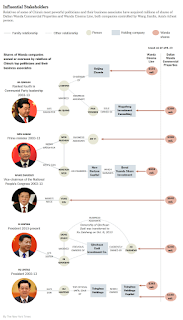
Wang Jianlin, a Billionaire at the Intersection of Business and Power in China - NYTimes.com
HONG KONG — He controls thousands of movie screens around the world, serving more filmgoers than any other cinema chain. He has invested billions of dollars in real estate projects across four continents. He is building skyscrapers that will redraw the skylines of London and Chicago. He is shopping for a Hollywood studio.
There are as many as 430 billionaires in China, more than in any country besides the United States. But Wang Jianlin stands out, and not just because he is the richest person in Asia, with a fortune estimated at more than $35 billion.
As his real estate and entertainment empire expands overseas, Mr. Wang, 60, has emerged as the rare private-sector tycoon in a position to advance Beijing's interests abroad, with clout in industries and communities around the world.
Prime ministers send him thank-you notes, and Hollywood's biggest stars fly to China when he summons them. In March, at an event to woo foreign investors, he was one of only a dozen businessmen to meet President Obama.
How the son of a foot soldier in Mao Zedong's Communist Revolution catapulted into the top tier of the global elite is an archetypal story of China's transition to capitalism and the outsize opportunities it presents those with talent or connections — or, in Mr. Wang's case, both. His story, though, is also singular: He built one of the world's most valuable real estate portfolios in a nation where the state retains ownership of all land.
A yearlong examination of his success by The New York Times casts a light on the murky intersection of business and power at the heights of the Chinese economy, where market competition is often warped by the whims of Communist Party leaders.
Entrepreneurs have powered rapid growth in China for more than three decades. But even the most successful businessmen here must still reach some accommodation with the party, which only a generation ago operated a socialist planned economy.
Mr. Wang says he has prospered by delivering what ambitious party officials crave: choice real estate developments that propel economic growth and bolster their careers. In return, he says, the officials sell him the rights to develop choice parcels of land at prices far below what his competitors pay.
His conglomerate, Wanda Group, is best known in China for its signature Wanda Plazas, massive shopping complexes with cinemas, office towers, hotels and apartments. Since building the first one in the northeastern city of Changchun in 2002, he has opened more than 100 of them in at least 70 other Chinese cities, generating the revenue that now finances his ambitions abroad.
But there is an aspect of his relationship with the authorities that Mr. Wang never raises in interviews and that has gone unreported in the many accounts of his success published in China and abroad: Relatives of some of the nation's most powerful politicians and their business associates own significant stakes in his company.
An extensive review of corporate records filed with the government identified several such investments made from 2007 to 2011, when Wanda was privately held and rarely sold shares to outsiders.
Among those given an early chance to buy a stake in his company was Qi Qiaoqiao, an active investor who is the elder sister of China's current president, Xi Jinping. (She sold or transferred her shares in the company in October 2013 to a longtime business associate.)
Other early investors included a business partner of the daughter of former Prime Minister Wen Jiabao, and relatives of two other members of the ruling Politburo at the time, Jia Qinglin and Wang Zhaoguo, according to the records and interviews with family members and business associates.
Together, their stakes in Wang Jianlin's real estate division, Dalian Wanda Commercial Properties, were valued at $1.1 billion when it held an initial public offering in Hong Kong in December. Their shares in Mr. Wang's cinema subsidiary were valued at $17.2 million when it listed separately in January. Their holdings in both companies are worth more than $1.5 billion now.
There is no indication that any of the politicians whose relatives and business associates owned shares in Wanda intervened on the company's behalf in any of its dealings with the government. Nor is there evidence that any of the politicians personally benefited from the windfall that these investors reaped. The investors and officials did not respond to written questions or could not be reached for comment.
Mr. Wang declined an interview request and did not respond to written questions submitted to Wanda. But in public remarks, he often uses the same phrase to describe how he manages his relationship with the authorities: "Stay close to the government and distant from politics."
"It's a fact that China's economy is government-led, and the real estate industry depends on approvals, so if you say you can ignore the government in this business, I'd say that's impossible," Mr. Wang told state television in a February interview. "I'd say it's hypocritical and fake to say that. ... But at the same time, for example, we don't pay bribes."
A Remarkable Winning Streak
It was September 2012, and students at the John F. Kennedy School of Government at Harvard were spellbound by an unusual lecturer, a short, plain-talking man with close-set eyes and a prominent widow's peak.
"In China, it's not easy for a company, especially a private company, to be successful and grow," he said through an interpreter. "The hardships they face are many times greater than in the United States."
It would not have been a particularly incisive observation from a member of the faculty. But the speaker that afternoon was Mr. Wang, and despite the hardships that he described, he was on a remarkable winning streak.
Months earlier, Mr. Wang had purchased AMC Entertainment Holdings, the second-largest theater chain in the United States. By year's end, his empire in China would include 66 Wanda Plazas, 38 five-star hotels, 980 cinema screens and 57 department stores, not to mention 63 karaoke saloons. Within a year, he would break ground on an $8 billion movie studio and theme park in the coastal city of Qingdao, flying in stars such as Leonardo DiCaprio, Nicole Kidman and John Travolta to celebrate.
With success came the familiar trappings of the megarich. Mr. Wang bought a Picasso painting at auction for $28.2 million. His wife socialized with Prince Albert of Monaco. His son hired a top Korean pop group to perform at his 27th birthday party.
Not content with just owning a yacht, Mr. Wang bought the British company that makes the luxury boats seen in James Bond films. In January, his company announced it was buying a stake in a Spanish soccer club.
"He is a force of nature," said Jeffrey Katzenberg, the chief executive of DreamWorks Animation, who has known Mr. Wang for three years. "He is a very, very strong personality, and he is extremely confident about what he is doing."
Mr. Wang's father was a veteran of the Communist Party's Long March, the arduous and deadly trek across China in the 1930s by the Communists that hardened a generation of revolutionaries, and Mr. Wang himself, the eldest of five brothers, followed him into the army as a teenager. In a 2013 appearance on state television, he recalled marching hundreds of miles through knee-deep snow in training exercises during Mao's fanatical Cultural Revolution.
"Many people couldn't make it," Mr. Wang said, but he did. He then spent the next 16 years rising through the officer ranks, an experience that colleagues say informs his management style. Even his most senior Wanda executives are required to punch in and out, for example, and tardiness is not tolerated, former employees say.
After leaving the military, Mr. Wang took a government job in the northeastern port city of Dalian. His big break there came in 1988, when he was transferred to a failing state-owned builder of residential apartment blocks. By his own account, he secured a loan with the help of an old army buddy and returned the company to profitability.
In 1992, the firm was restructured as one of China's first shareholding companies, and over the next decade, Mr. Wang oversaw its privatization, emerging as its majority owner.
The mayor of Dalian for much of that time was Bo Xilai, a politician who was the son of an influential party elder and who would rise to the Politburo before falling from power in a stunning corruption and murder scandal in 2012.
Mr. Wang was an extraordinary benefactor to Dalian during Mr. Bo's tenure, buying the city's soccer team, which helped make it a national champion, and donating tens of millions of dollars to build schools.
Since Mr. Bo's fall, Mr. Wang has sought to distance himself from him. In a recent interview, he said he struggled during those years because he refused to pay bribes and did not get along with Mr. Bo. That limited his access to land, he said, which Mr. Bo's administration would not sell him.
"We still made money, but it wasn't a pleasant time," Mr. Wang told Bloomberg Markets magazine.
Because the state retains formal ownership of all land in China, those who want to build on it must have the state's blessing. Local governments have depended for years on the sale of long-term rights to develop land to finance their operations. But who gets which parcels, and at what price, is as much a political decision as an economic one.
Photo Mr. Wang has emerged as the rare private-sector tycoon in a position to advance Beijing's interests abroad, with international clout. Credit Adam Dean for The New York Times
Mr. Wang says his company is so good at delivering benefits to the cities where it builds that local governments now compete for his business and he turns down more than two out of every three proposals.
"We thus can take the initiative, and we have the bargaining power," he told the students at Harvard. That means he acquires land at less than half the cost to his competitors, he added.
Even as property prices set records in China, the price that Dalian Wanda paid for access to land fell by more than 40 percent from 2011 to 2014, according to its I.P.O. prospectus.
Wang Yongping, vice chairman of the China Commercial Real Estate Association, said local officials were eager to work with Wanda because of the tax revenue its projects bring them and because it has a reputation for getting things done fast. The company can finish a Wanda Plaza at what it calls Wanda Speed, or within 18 months.
"Chinese government officials love to have achievements when they are in office," Wang Yongping said. "Eighteen months might determine whether they can become a district chief or a provincial party secretary."
But some in power have other reasons to root for Wang Jianlin.
A Paper Trail to the Elite
In July 2007, Mr. Wang had built only a handful of Wanda Plazas. He had yet to make his first billion dollars, and few outside China had heard of him or his company. The Hurun Rich List, which tracks the net worth of the wealthiest people in China, ranked him 148th.
But late that month, a newly formed firm in Beijing, Minghao Holdings, acquired a 2.5 percent stake in Mr. Wang's flagship company, Wanda Group, becoming its largest external shareholder, according to corporate records. There was only one other outside shareholder at the time, a local real estate company in Dalian run by a friend.
Then, two months later, another newly established firm in Beijing, Wugufeng Investment Consulting, took a 1.53 percent stake in the main company that Mr. Wang used to hold his shares in Wanda Group, becoming its fifth shareholder, the records show.
The documents do not indicate why the two Beijing firms were invited to become early investors in Mr. Wang's business. But the paper trail from the companies leads to relatives of two men sitting at the time on the Communist Party's ruling Politburo: Jia Qinglin, a longtime party boss of the Beijing municipality who ranked fourth in the party leadership, and Wang Zhaoguo, a senior legislator who was the leading force behind a landmark law providing legal protections for private property.
Wang Zhaoguo's son, Wang Xinyu, was the controlling shareholder of the first firm, which later transferred its stake in Wanda to a young woman named Yang Xin, the records show. Ms. Yang is the Politburo member's niece, according to Wang Zhao'an, a cousin who serves as party chief in the family's home village in Hebei Province.
The owner of the second firm is listed in the records as Pan Yongbin, 63, who shares a business address, staff and phone numbers with a Beijing investment firm run by Mr. Jia's son-in-law, Li Botan. Mr. Pan is also listed as a board member of several firms owned by Mr. Li, including his main investment company.
As Wanda prospered in the years that followed, the value of these early stakes skyrocketed.
The firm controlled by Wang Zhaoguo's son paid less than $500,000 for its stake, according to Wanda's filings with the government, though the firm's own records do not show the transaction. The documents are more complete for the second firm, showing a payment of less than $200,000 for its stake. Those two stakes are now worth more than $640 million and $250 million.
Neither Politburo member was in a position to directly set the price or approve the sale of land-use rights to Wanda. But party institutions under the two men have showered Wang Jianlin with public recognition.
In March 2008, Mr. Wang was one of only three mainland billionaires named to the standing committee of the Chinese People's Political Consultative Congress, a national advisory body, led by Mr. Jia, that is made up of people whom the party leadership deems influential. The appointment amounted to a seal of approval by top party leaders, said one Chinese businessman who serves on a similar body and spoke on the condition of anonymity to protect his position.
In June 2007, Mr. Wang was also named an outstanding private entrepreneur by a party-run industry association, the first of five awards bestowed upon him over the next four years from groups led by or associated with Wang Zhaoguo.
Honors like these can signal to local officials and potential business partners that their recipients are well connected. "At least within China, people will be much more willing to do business with you, and much less likely to offend you," said Victor Shih, a scholar at the University of California, San Diego.
After the global financial crisis in late 2008, China's property market took a nose dive. Real estate stocks in Shanghai ended the year down 65 percent.
But Wanda had a banner year, breaking ground on seven new Wanda Plaza complexes — setting a record — and propelling Wang Jianlin to 20th on the Hurun list of China's richest people, with a fortune estimated at $2.3 billion.
The next year, Wanda distributed shares to outsiders again, privately selling an 8.5 percent stake in the company.
Among the eight new investors was a Beijing firm owned through a network of holding companies by Qi Qiaoqiao, the sister of Xi Jinping, and her husband, Deng Jiagui.
Ms. Qi and Mr. Xi are members of a privileged elite consisting of the offspring of senior party officials. Their now deceased father, Xi Zhongxun, was a military comrade of Mao and later became a vice premier and a pioneer of economic reform.
Ms. Qi worked in a variety of political and military posts during her career before becoming a businesswoman. During that time, her younger brother, Mr. Xi, was working his way up through the ranks in provincial government posts.
It is not known why Ms. Qi and her husband were offered the chance to invest in Wanda. By 2009, she was already a wealthy investor with business relationships across the country. Meanwhile, her brother had become China's vice president and was the consensus candidate to become the party's next leader.
Photo When Mr. Wang broke ground on an $8 billion movie studio and theme park in the coastal city of Qingdao in 2013, the stars he flew in to celebrate included Leonardo DiCaprio. Credit Jason Lee/Reuters
Ms. Qi and Mr. Deng did not respond to a request for comment. But records show the couple began selling off or transferring hundreds of millions of dollars in investments in 2012 as President Xi embarked on a high-profile crackdown on official corruption. The motivation behind this sell-off is unclear but it had the effect of reducing her brother's political vulnerability as his campaign targeted thousands of officials.
In many cases, the couple sold their investments to individuals with no clear connection to them.
But the shares in Wanda — valued at $240 million now, up from the $28.6 million the couple paid for them in 2009 — were transferred to a longtime business associate on Oct. 8, 2013. The records give no indication of the price paid by the business associate, who has served the couple in various corporate posts for more than a decade.
Another new shareholder in Wanda was an investment fund owned in part and managed by a subsidiary of Tsinghua Holdings, the investment arm of Beijing's prestigious Tsinghua University. At the time, the top official at Tsinghua Holdings was Hu Haifeng, the son of Hu Jintao, then China's president. There is no indication Hu Haifeng personally benefited from or held any shares in Wanda himself.
Some of the individuals given an early chance to invest in Wanda are difficult to identify. One of them, Jin Yi, acquired a stake in 2009 that is now worth about $250 million. But the address on her identity card is incomplete, and her name is not included on the official registry of residents in the neighborhood listed.
Corporate records indicate, however, that Ms. Jin is a business associate of Wen Ruchun, the daughter of Wen Jiabao, the prime minister from 2003 to 2013. Ms. Jin is listed as one of three partners in a Beijing real estate firm alongside Lily Chang, an alias used by Ms. Wen.
Promoting Chinese Culture
Seated between Lloyd Blankfein, the chief executive of Goldman Sachs, and Nick Clegg, the deputy prime minister of Britain, Wang Jianlin had little to say through much of a panel discussion last year at the World Economic Forum in Davos, Switzerland, the annual gathering of the wealthy and powerful. But when a speaker suggested that China's focus on territorial disputes diminished its influence in Asia, the billionaire bristled.
"This is a discussion on economics today and shouldn't delve into politics," Mr. Wang snapped. "You are publicly saying bad things about China — at the very least, I don't think this is very polite."
As his fortune has climbed and his investments have stretched overseas, Mr. Wang has emerged as an outspoken advocate for his homeland. In interviews and speeches, he tends to present himself as the pragmatic face of big business in China, delivering a soothing message of opportunity to foreign audiences anxious about the country's rise.
"Wang Jianlin is a perfect instrument for that from the party's point of view," said Joseph Nye, the Harvard professor who coined the term "soft power" and was the panelist scolded by Mr. Wang at Davos.
Mr. Wang is effective in part because he is no longer simply a Chinese real estate developer. As Beijing sought to cool its property sector in recent years, he diversified by shifting investments abroad and into the culture and entertainment sector, including his network of movie theaters, which became the world's largest in 2012 with the purchase of AMC's 4,000-plus screens in the United States.
The strategy coincided with a policy push by the Chinese leadership to expand the nation's cultural influence both overseas and at home, where younger generations have increasingly turned to Western music, television and films.
A communiqué issued by the party's Central Committee in October 2011 cited an "urgency for China to strengthen its cultural soft power and global cultural influence."
"After this document, Wanda started to put a lot of effort into developing the cultural industry," said Zhang Lihua, a scholar at the Tsinghua-Carnegie Center for Global Policy in Beijing.
Investors connected to senior party leaders were able to get in early on Wanda's move. In December 2010, the investment firm of Mr. Jia's son-in-law acquired a $9 million stake in Wanda's cinema subsidiary, records show. As of Monday, the stake was worth $131 million.
The records also show another early investment that same month by an investment fund run by New Horizon, a private equity firm co-founded by Mr. Wen's son, Winston Wen. On Monday, that stake was valued at $526 million.
The Central Committee's decision resulted in new policies that benefited real estate companies such as Wanda.
Local governments, for example, were told to prioritize the sale of land-use rights to companies that built projects that promote Chinese culture. And state-owned banks were told to offer loans for cultural undertakings at home and abroad. The state export-import bank agreed to help finance Wanda's overseas investments, backing its acquisition of AMC.
In addition to investing in the movie industry, Wanda has opened a series of amusement parks that promote Chinese culture, including one that features a building in the shape of a Chinese teapot. Mr. Wang says it will compete with a Disneyland under construction in Shanghai.
"No matter how good Disney is, it is still American culture," he said after the groundbreaking ceremony last year. "We hope to use Chinese culture."
Xu Han, a scholar at the University of Pennsylvania who has studied the company, said Wanda's overseas expansion was driven in part by Beijing's desire to see the nation's premier companies build a presence abroad. But he said the firm was more interested in profit than in directly influencing public opinion about China.
"The central government's objective is very clear," he said. "To have a very successful Chinese company is good for China."
When Mr. Wang bought AMC, he retained the American management team and emphasized that his company would not dictate what films were shown in American theaters.
But with China forecast to surpass North America in box office revenue by 2018, Hollywood is already focused on serving Chinese filmgoers and satisfying the censors who determine what foreign films can be shown in Chinese theaters.
Mr. Wang often notes that the Chinese market will be twice the size of the North American market by 2023.
Foreigners need to heed this new reality, he warned when he hosted Mr. DiCaprio and Ms. Kidman for the 2013 groundbreaking of his Qingdao studio.
"Those in the world film industry who realize this first and are among the first to cooperate with China," he said, "will be the first to reap the benefits."
Jonathan Ansfield contributed reporting from Beijing and Shigezhuang, Hebei. Julie Hirschfeld Davis contributed reporting from Washington. Kiki Zhao contributed research from Beijing.
A version of this article appears in print on April 29, 2015, on page A1 of the New York edition with the headline: Billionaire at the Intersection of China's Business and Power.


